
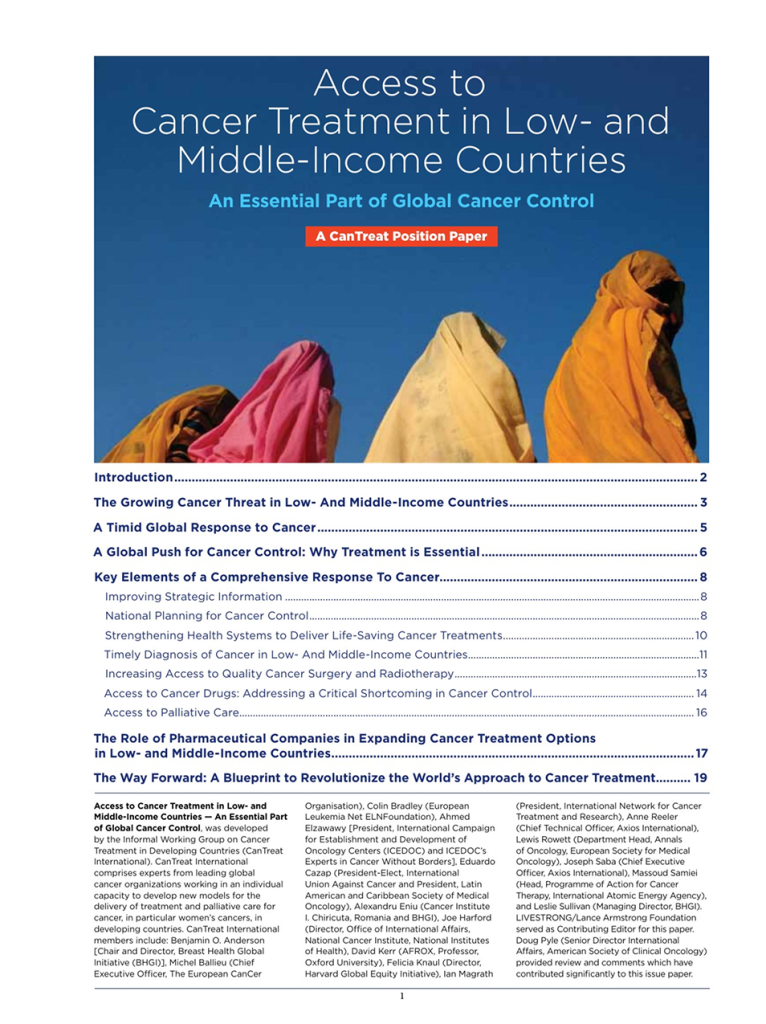
This position paper argues that treatment access, not prevention alone, is essential to addressing the rising global cancer burden, since more than half of the world’s cancer cases already occur in low- and middle-income countries, which receive only a small share of global cancer funding. Drawing on lessons from the global HIV/AIDS response, which proved that large-scale treatment access is achievable even in resource-poor settings, the paper lays out a five-point blueprint for building sustainable cancer care worldwide, covering health systems, financing, drug access, and advocacy.
Publication
Access to Cancer Treatment in Low- and Middle-Income Countries: An Essential Part of Global Cancer Control
CanTreat International
UICC 2010
Published
Key Takeaways
This position paper argues that treatment access, not prevention alone, is essential to addressing the rising global cancer burden, since more than half of the world’s cancer cases already occur in low- and middle-income countries, which receive only a small share of global cancer funding. Drawing on lessons from the global HIV/AIDS response, which proved that large-scale treatment access is achievable even in resource-poor settings, the paper lays out a five-point blueprint for building sustainable cancer care worldwide, covering health systems, financing, drug access, and advocacy.
- Cancer cases in low- and middle-income countries are projected to more than double by 2030, yet these countries have only about a third of the world’s radiotherapy machines despite carrying 85% of the global disease burden.
- Survival rates reveal the human cost of this gap: breast cancer survival is 84% in the U.S. but as low as 12% in some low-income countries, and childhood cancer cure rates fall from 75% in wealthy countries to just 10-15% in the poorest ones.
- The paper points to the global AIDS response as proof that scaling up complex treatment in resource-limited settings works: tiered drug pricing, generic manufacturing, and health system investment helped antiretroviral therapy reach 4 million people in under a decade.
- Real-world pilot programs already demonstrate that affordable, effective cancer care is achievable, from breast cancer treatment scale-up in Ghana and Ethiopia to Thailand’s use of trade rules to license generic cancer drugs, but the paper calls for far greater investment, national planning, and advocacy to bring these efforts to scale worldwide.
Resources
Recent Publications