
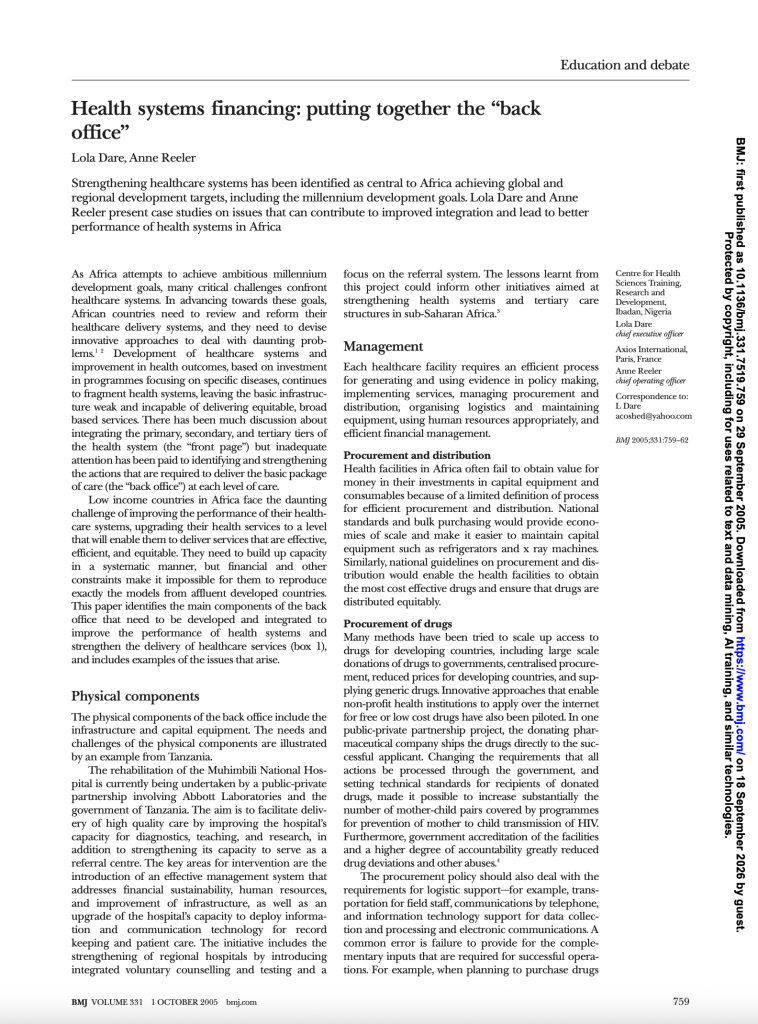
This article argues that strengthening African health systems requires more attention to the “back office” — the underlying infrastructure, management, financing, and relationship-building functions that support care delivery — rather than focusing narrowly on individual disease programs. Drawing on case studies from Tanzania, Nigeria, and other African countries, the authors identify the key components needed for health facilities to function effectively and sustainably.
Publication
Health Systems Financing: Putting Together the “Back Office”
Dare L & Reeler A.
British Medical Journal
Published
Key Takeaways
This article argues that strengthening African health systems requires more attention to the “back office” — the underlying infrastructure, management, financing, and relationship-building functions that support care delivery — rather than focusing narrowly on individual disease programs. Drawing on case studies from Tanzania, Nigeria, and other African countries, the authors identify the key components needed for health facilities to function effectively and sustainably.
- Health systems in Africa are often weakened by an overemphasis on disease-specific funding, which leaves basic infrastructure, procurement, and financial management systems under-resourced and fragmented.
- Effective “back office” functions include reliable infrastructure and equipment maintenance, efficient drug procurement and distribution, sound financial management, and strong human resource practices — all of which are frequently overlooked in donor-funded programs.
- Countries like Sri Lanka, Chile, and Nigeria’s Ondo State offer examples of how integrated, locally-led health system investments can achieve strong outcomes even with limited resources.
- Sustainable improvement in African health outcomes will require development partners and governments to invest more deliberately in these foundational systems, rather than channeling nearly all funding toward specific diseases.
Resources
Recent Publications