
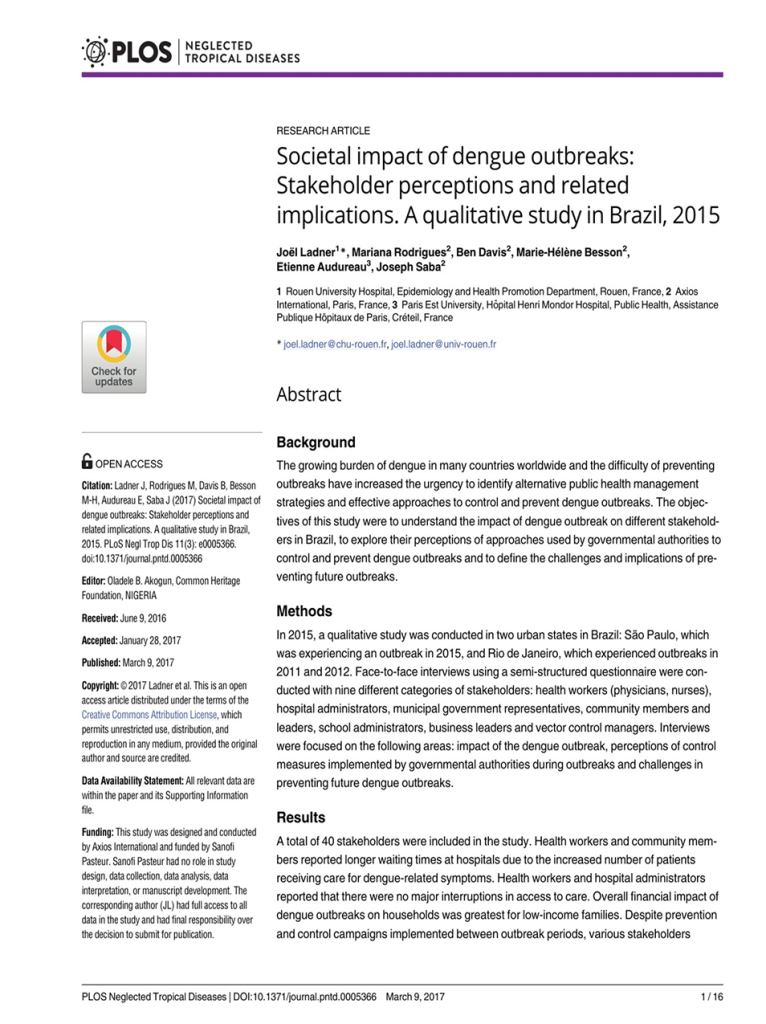
This qualitative study interviewed 40 stakeholders, including doctors, hospital administrators, government officials, and community members, across two Brazilian states to understand how dengue outbreaks ripple through healthcare systems, households, schools, and local economies. Outbreaks strained hospitals with long wait times and eroded public trust in government prevention efforts, even though the direct financial cost to most families was relatively small.
Publication
Societal Impact of Dengue Outbreaks: Stakeholder Perceptions and Related Implications, Brazil
Ladner J, Rodrigues M, Davis B, Besson MH, Audureau E, & Saba J.
PLOS Neglected Tropical Diseases
Published
Key Takeaways
This qualitative study interviewed 40 stakeholders, including doctors, hospital administrators, government officials, and community members, across two Brazilian states to understand how dengue outbreaks ripple through healthcare systems, households, schools, and local economies. Outbreaks strained hospitals with long wait times and eroded public trust in government prevention efforts, even though the direct financial cost to most families was relatively small.
- Hospitals and clinics saw major spikes in patient volume and wait times during outbreaks, though administrators reported no actual shortages of staff or medical supplies.
- The financial burden of dengue fell hardest on low-income households, mainly through the cost of transportation to seek care rather than treatment itself.
- Most stakeholders felt government prevention efforts were reactive rather than proactive, arriving only after outbreaks had already escalated, which fueled public mistrust.
- Highlights that fighting dengue effectively requires not just medical response but sustained community engagement and government credibility built between outbreaks, not just during them.
Resources
Recent Publications